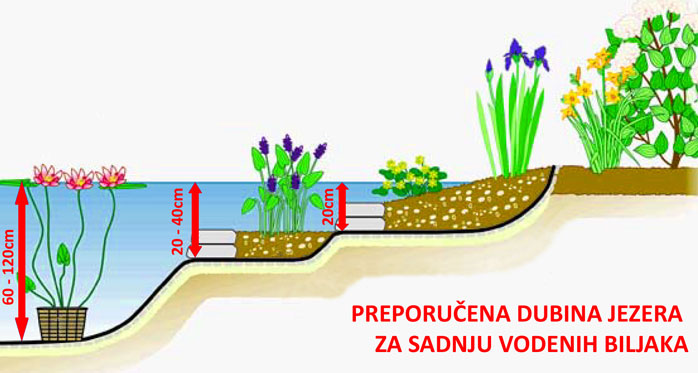
The construction process consists of several basic steps:
- excavation and leveling of the terrain
- waterproofing
- stone lining of the lake
- installation of pumps, underwater reflectors, filters and other equipment
- planting plants in and around the fountain
Excavation of the lake and leveling of the terrain
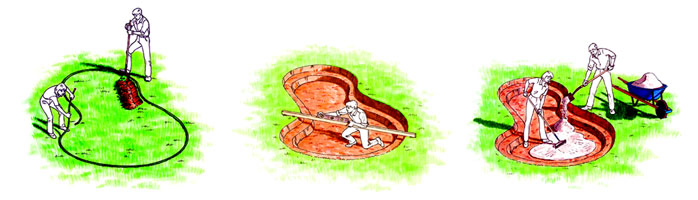
Before digging, mark the desired shape of the pond with string or flexible hose. Dig the hole in steps. The shallower parts are closer to the coast, and the deeper parts are in the middle. This will help you mask the bottom with stones more easily, and thus you will have plateaus for planting aquatic plants. At the same time, care should be taken to ensure that the rim is level. If you want water lilies to be found in your lake, then its depth must be at least 50 to 100 cm. The entire bed of the lake should be covered with the finest clean sand in a layer three to five cm thick.
Waterproofing
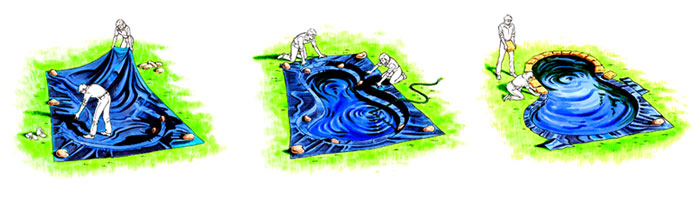
Waterproofing is one of the most important things in making a fountain because you can replace everything else relatively easily. A poor choice of waterproofing means ruining everything you’ve done. If you decide on special foils for artificial lakes, you will certainly not go wrong. In practice, PVC foils are most often used. They are reliably waterproof, do not rot in the ground, are resistant to UV radiation and frost, are elastic and very easy to work with. They are easy to join or patch. The special adhesive for the foil makes this job much easier.
If it is possible, we sincerely recommend that you place elements for emptying the fountain at the lowest point of the bottom of the lake. It will make your maintenance much easier and you won’t regret it if you do it.
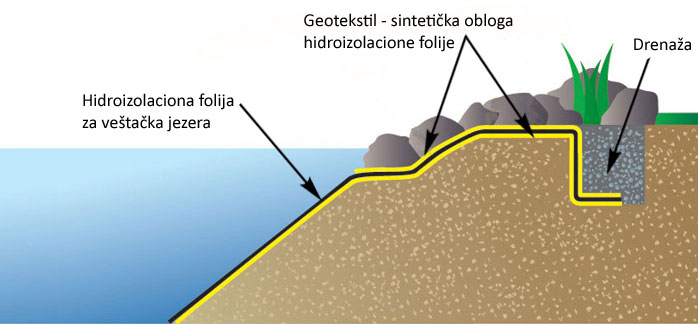
A protective base must be placed under the foil in order to protect the foil from stones, roots, glass and other things that can be found in the ground. The substrate is a special synthetic material – geotextile. It is first laid on a five cm thick layer of fine and clean sand, and only then is the foil placed. The geotextile is placed everywhere under the foil. In places where the fountain is lined with heavier stones, the foil should be protected with geotextile. Around the edge of the lake, a part of the foil should be buried a little and turned outwards, and then buried with pebbles. Thus, a drainage channel is formed around the fountain, which prevents excess overflow and rainwater from penetrating under the waterproofing foil, as this could eventually lead to the undermining of the fountain and the occurrence of erosion in that area.
When sizing the garden pond, keep in mind that the waterproofing film is sold in standard widths of 2, 4, 6, 8 or 10 meters. On sale, pieces of foil can be cut to a full meter length up to a maximum length of 25 meters, with the exception of foil with a width of 2 meters, whose maximum length can be 50 meters.
Formula for approximate calculation of the required amount of film or geotextile for the lake:
P = (A+2h+0,5m) x (B+2h+0,5m)
P – required area of foil or geotextile (m2)
A – the largest length of the lake (m)
B – the largest width of the lake (m)
h – maximum depth of the lake (m)
Note:
For the calculation, take into account the measurements of the longest and widest dimensions of the lake.
You can always increase the obtained measurements a little more due to possible wrinkling of the foil during work.
Stone lining of the lake
Before laying the stones, fill the pond with water so that the waterproofing film adheres well. Then throw out the water so that it does not get in the way during work. You can fix the stones with mortar everywhere or only in the places where it is needed. When working, be careful not to damage the foil with a sharp object. If by any chance this happens, don’t worry. With a special glue for foil, you can easily and quickly patch up the damage.
Firm the pots with plants in the lake and mark them with stones. You can cover the coast with pebbles in the form of a beach. You can also finish the rim of the fountain by arranging stone slabs or stones of interesting colors and shapes.
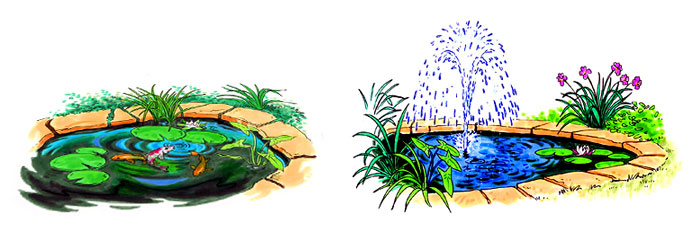
Installation of pumps, underwater lighting, filters and other equipment
The next thing missing is the pump. Which pump you choose depends on what effect you want to achieve. For a waterfall, water hemisphere or geyser, you will also need attachments – nozzles. If you want the water to flow down the stone, you will achieve this by connecting the pump and the source with pipes or hose of the appropriate diameter.
Underwater reflectors will give the pond a truly exceptional charm in the evening. It’s best if you illuminate places where water moves (spring, waterfall, waterfall).
Maintaining the quality of the water in the fountain will be much easier with BIO-filters, UV-C filters, algaecides, a vacuum cleaner for cleaning the fountain and other chemical products from our offer.
Cross section of the garden lake
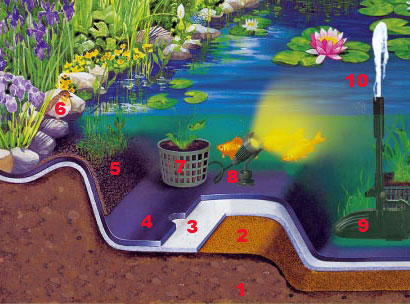
- country
- a layer of sand about 5 cm thick
- geotextile
- waterproofing film for artificial lakes
- coconut netting for planting plants on steep banks
- stone around the fountain
- a pot with a water plant
- underwater reflector
- submersible fountain pump
- nozzle
Planting plants
When it comes to the lake, it gets its full appearance only by planting plants.
The first thing that comes to mind when it comes to aquatic plants is surely water lilies. The water lily, because of the beauty of the flower, is the king of aquatic plants. In addition to the decorativeness of the flower, its large leaves that float and create a shadow underneath are beautiful and important. This way, the water does not heat up too much in the summer, which pleases the fish, and to some extent controls the appearance of algae. For planting water lilies, the depth of the lake must be between half and one meter, although recently, mini-forms have also appeared that tolerate shallower water.
It is good to plant water lilies and other aquatic plants in plastic perforated baskets. So you can easily control their growth and remove them for eventual division and transplanting. Fill the basket with clay soil, plant the plants, and cover the top with gravel so that the fish do not disturb the water. When lowering the basket with water lilies, make sure that the leaves float on the surface of the water. Water lilies are planted in a sunny place, in still, still water, away from waterfalls and waterfalls. If the conditions for water lilies do not exist, an alternative is to plant the Aponogeton plant. It also blooms (not as attractively) and can tolerate partial shade and stagnant water.
There are plants that float on the surface of the water, they should not be planted, but simply lowered into the water. These are Hydrocharis, Lemna (small leaves), Pistia (decorative, but not resistant to even moderate cold). Oxygenating plants are also important for the balance in the lake. The most famous is certainly the buttercup (Ranunculus aquaticus).
The choice of plants for the coastal area is large. It is characteristic of them that their roots are in the water, and the leaves and flowers are outside the water. These are various types of grass (Acorus, Carex, Juncus, Equisetum), but also many decorative flowers (Iris, Alisma, Calla). Small-flowered Caltha and Houttuynia are also decorative. Don’t miss planting rushes (Typha), especially the new mini-varieties, then hosta, which is particularly suitable for shady places.
The best period for planting aquatic plants is May – June. Do not plant them in ordinary soil, but in a mixture of sand and loam or a special mixture. Aquatic vegetation is spreading rapidly. Take care that it should not cover more than a third of the surface of the lake. Avoid fertilizing, except for water lilies, and even that sparingly. Excessive fertilization promotes the appearance of algae.
Collect leaves and algae from the water regularly. If it has accumulated, a sludge vacuum cleaner will be most helpful. Remove yellowed and wilted leaves.
Do not prune reeds and rushes before winter because their stems, like tubes, deliver oxygen to the pond.