
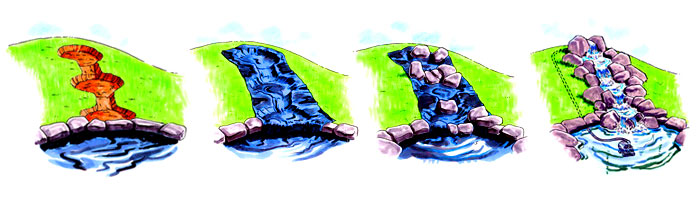
A stream with a spring can easily be added to the garden pond during construction. The slope next to the lake will contribute to the fact that the spring, stream and waterfalls on it look as natural as possible. The slope for the spring can also be formed with earth from the excavation for the lake. The method of building a spring with a stream is similar to that for a lake. The foundation for the stream should be dug in cascade for stability. When building springs and waterfalls, care should be taken to ensure that the foil is always above the planned water level. It is safest to stick the stream film and the lake film to each other. This is what a special adhesive for foil is used for. Foil glue can be avoided by skillfully overlapping the stream foil over the lake foil, but it is safer when the foils are glued. After placing the foil, and before building with stones, the hose from the pump to the source should be installed. The diameter of the hose depends on the capacity of the pump and its length. The hose must not be smaller in diameter than necessary. We recommend that you consult us when choosing a pump and hose. When you buy our fountain equipment from us, you can get all the useful tips that will help you make the fountain you build high-quality. Stones at waterfalls, springs and other critical places should be reinforced with cement mortar.
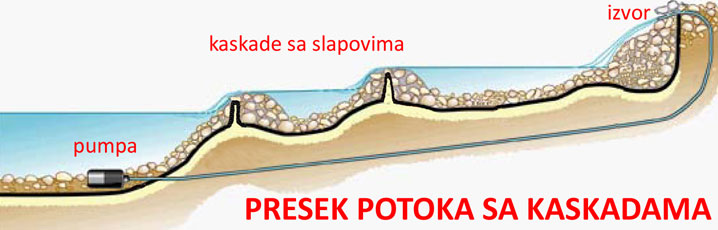
Formula for approximate calculation of the required amount of film or geotextile for a stream with a source:
P = (L+∆h+Nx2d+0,5m) x (B+0,5m)
P – required area of foil or geotextile (m2)
L – stream length (m)
∆h – height difference from the maximum water level in the lowest lake to the top of the spring (m)
N – number of cascades in the stream (m)
D – the greatest depth of the stream (m)
B – the greatest width of the stream (m)
Note:
For the calculation, take into account the measurements along the longest edges of the stream, especially if the stream is long and winding. The obtained measurements should always be increased a little more due to possible wrinkling or overlapping of the foil during work.
Formula for approximate calculation of the required amount of film or geotextile for one segment – stream cascade (for work from segments with overlapping film on cascades):
P = (L+∆h+Nx2d+0,5m) x (B+0,5m)
P – required area of foil or geotextile (m2)
L – segment length – stream cascades (m)
∆h – height difference from the maximum water level of the lower segment – stream cascade to the overflow of the higher segment – stream cascade (m)
d – the greatest depth of the segment – stream cascades (m)
B – the largest width of the segment – stream cascades (m)
Note:
The calculation should be done for each segment – stream cascade individually.
For the calculation, take into account the measurements along the longest edges of the stream, especially if the stream is long and full of curves. The obtained measurements should always be increased a little more due to possible wrinkling or overlapping of the foil during work.